

Quartz vs. Granite vs. Quartzite: Which Countertop Is Right for Your Kitchen?
Quartz, granite and quartzite can all make great kitchen countertops, but they’re not interchangeable. The biggest difference starts with what they are: granite and quartzite are natural stones, while quartz countertops are engineered surfaces.
That difference affects everything from how the countertop looks to how much maintenance it needs.
If you want something easy to maintain with plenty of design options, quartz may make the most sense. If you love the variation and character of natural stone, granite is worth considering. And if you want the dramatic movement of natural stone with excellent durability, quartzite can be a beautiful option.
Here’s how the three compare.
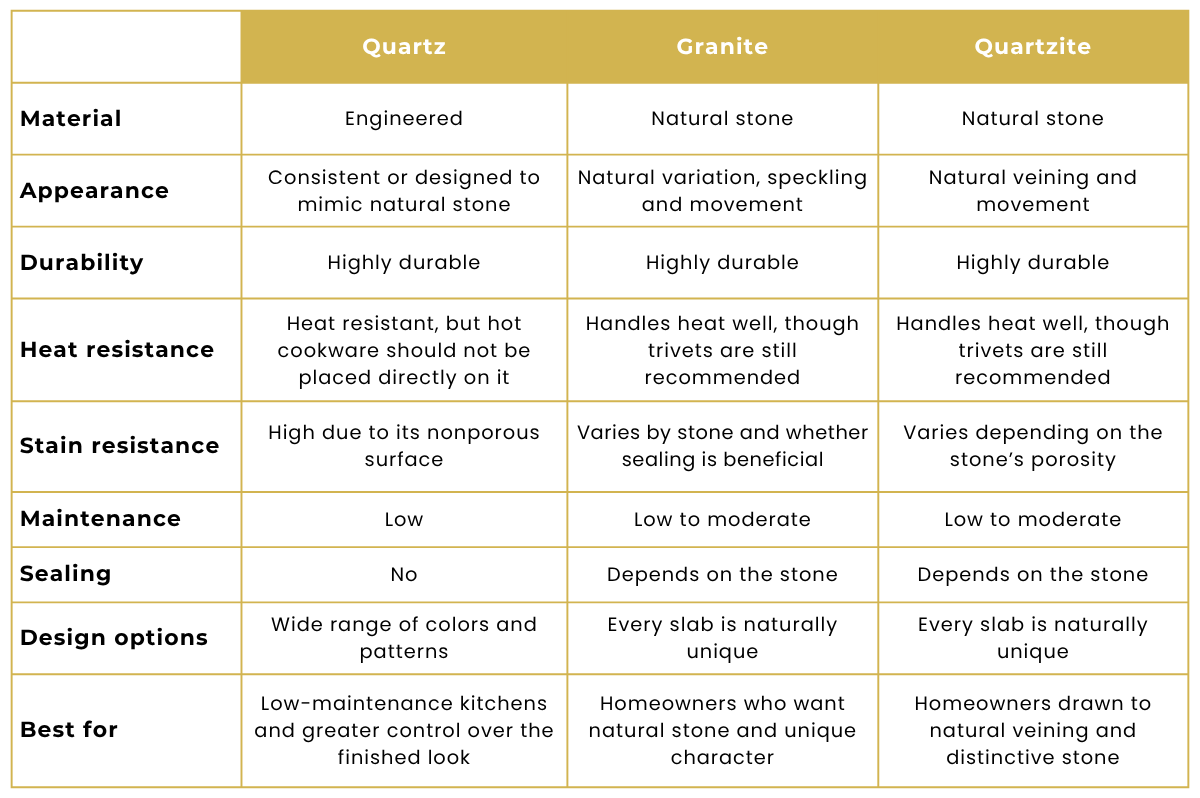
What Is the Difference Between Quartz, Granite and Quartzite?
One of the easiest mistakes to make when shopping for countertops is assuming quartz and quartzite are basically the same material.
They’re not.
Quartz countertops are engineered. They’re manufactured using quartz minerals along with other materials, which allows manufacturers to create a wide variety of colors, patterns and finishes. Because the finished surface is nonporous, quartz does not need to be sealed and is relatively simple to maintain.
Granite is a natural stone. It is quarried, cut into slabs and fabricated for your kitchen. Because it comes directly from nature, no two slabs are exactly the same. Depending on the granite you choose, you might see subtle speckling, bold movement, mineral deposits or dramatic color variation.
Quartzite is also a natural stone, formed when sandstone undergoes intense heat and pressure within the earth. Like granite, each slab has its own natural pattern. Many quartzites are known for flowing veins and movement, making them especially appealing if you like the look of natural stone.
So while all three can give you a durable kitchen surface, the choice comes down to much more than appearance.
Quartz Countertops: Pros and Cons
Quartz has become a popular kitchen countertop material for a simple reason: it combines durability with very little day-to-day maintenance.
Because quartz countertops are engineered to be nonporous, they don’t require sealing. Everyday cleaning is generally straightforward, and the surface offers strong resistance to common household stains.
Quartz also gives you a lot of control over the design.
You can find clean whites, warm neutrals, darker tones, subtle patterns and designs created to resemble the veining found in marble and other natural stones. That makes quartz useful when you have a very specific kitchen design in mind and want to know more or less what the finished countertop will look like.
There is one important trade-off: heat.
Quartz is heat resistant, but the resins used in engineered quartz can be affected by excessive or sustained heat. Manufacturers recommend using trivets or hot pads rather than placing hot pots, pans and heat-generating appliances directly on the countertop.
Quartz may be right for you if:
You want a countertop that doesn't need sealing.
Easy maintenance is high on your list.
You want plenty of control over color and pattern.
You like the appearance of natural stone but prefer a more predictable design.
Your kitchen gets a lot of everyday use.
Granite Countertops: Pros and Cons
Granite is a good choice if part of what you want from your countertop is the stone itself.
Every slab is different. Colors, mineral patterns and movement vary naturally, which means the countertop you choose won't look exactly like anyone else's.
Granite is also a durable material that performs well in a working kitchen and handles heat well. Even so, using trivets is still good practice for natural stone countertops.
Maintenance is where granite is sometimes oversimplified.
You may have heard that all granite has to be sealed regularly, but that isn't necessarily true. The Natural Stone Institute notes that many granite countertops do not require sealing, while others can benefit from it. The right approach depends on the specific stone.
That makes choosing the actual slab — and understanding how to care for it — an important part of buying granite.
Granite may be right for you if:
You want a genuine natural stone countertop.
You like natural variation rather than a perfectly consistent pattern.
Heat resistance matters to you.
You want to select the exact slab that will go into your kitchen.
You don't mind following the care recommendations for your particular stone.
Quartzite Countertops: Pros and Cons
Quartzite often gets attention because of its appearance.
Many slabs feature the kind of flowing veins, movement and natural variation people associate with marble, but quartzite is a hard, durable natural stone that can perform very well as a kitchen countertop.
It also handles heat well.
Like granite, however, quartzite isn't one completely uniform material. Different quartzites can have different levels of porosity. Some may benefit from sealing while others may not, so care recommendations should be based on the actual stone you choose rather than a blanket rule.
It's also important to make sure you're comparing true quartzite when shopping. Stone names used commercially don't always tell you everything about a slab's geological composition, which is one reason working with a knowledgeable stone supplier or fabricator matters.
Quartzite may be right for you if:
You want natural stone with distinctive movement and veining.
You like the look of marble-style countertops but want to explore a harder natural stone.
Durability and heat resistance are important.
You appreciate the fact that every slab is different.
You're comfortable with care requirements that can vary from one stone to another.
Which Is More Durable: Quartz, Granite or Quartzite?
All three are durable enough to be strong options for kitchen countertops.
That may not be the dramatic answer people expect, but durability alone usually isn't a good reason to eliminate any of them.
Quartz is engineered to create a hard, durable surface. Granite has long been used in kitchens because of its strength and ability to stand up to everyday use. Quartzite is also an exceptionally hard natural stone.
Whichever you choose, durable doesn't mean indestructible.
Using cutting boards, cleaning spills promptly and following the care instructions for your particular countertop will help protect the surface and finish over time.
Which Requires the Least Maintenance?
If minimizing maintenance is your biggest priority, quartz has the advantage.
Its nonporous surface doesn't need to be sealed, and routine cleaning is generally simple.
Granite and quartzite are also relatively easy to care for, but because they're natural stones, their needs can vary. Some slabs may benefit from an impregnating sealer to increase stain resistance, while others may not need one.
And sealing doesn't make natural stone completely stain-proof. It simply helps make the surface more resistant to staining.
For someone who wants as few maintenance considerations as possible, quartz is the more straightforward choice.
Which Handles Heat Better?
Granite and quartzite generally have the advantage when it comes to heat.
Quartz can tolerate heat, but excessive temperatures and sudden temperature changes can affect the resins in the material. Quartz manufacturers specifically recommend using trivets or hot pads for hot cookware and countertop appliances that generate heat.
Natural stone is generally more tolerant of high temperatures, but that doesn't mean your countertop should double as a landing spot for pans straight out of the oven.
A trivet costs very little. Your countertops don't.
Using one is a good habit no matter which material you choose.
Which Is More Resistant to Stains?
Quartz has an advantage here because it is nonporous.
That makes it highly resistant to common kitchen stains and eliminates the need for a separate sealer.
Granite and quartzite can also offer excellent stain resistance, particularly when the stone is properly cared for and sealed when appropriate. But because natural stones vary in porosity, there isn't one rule that applies to every slab.
With any of the three, wiping up spills instead of leaving them sitting on the countertop is still the best habit.
Which Offers the Most Design Options?
This really depends on what you mean by “options.”
If you want the widest selection and greater consistency, quartz is difficult to beat. Because it's engineered, manufacturers can produce everything from solid colors and subtle patterns to dramatic veining designed to recreate the appearance of natural stone.
Granite and quartzite offer something quartz can't manufacture in quite the same way: a slab created entirely by nature.
The veining, mineral deposits and color variations you see are part of that particular piece of stone. If you find a slab you love, that uniqueness can become a major part of the kitchen design.
Neither approach is better. Some homeowners want consistency. Others walk into a showroom, see one particular slab and immediately know that's the one.
Which Countertop Is Best for a Busy Kitchen?
For a kitchen that's constantly being used, quartz is often the easiest option to live with because it combines durability, stain resistance and minimal maintenance.
But that doesn't automatically make it the best countertop for every busy kitchen.
If you cook frequently and heat resistance is a major concern, granite or quartzite may appeal to you more. If design is the priority and you want a one-of-a-kind natural stone island to become the focal point of the room, you may also decide that a little additional care is worth it.
Think about how you actually use your kitchen, not just how you want it to look in photos.
Quartz vs. Granite vs. Quartzite: Which Should You Choose?
There isn't one countertop material that wins every category.
The better question is: what matters most in your kitchen?
Choose quartz if you want a durable, low-maintenance countertop, don't want to worry about sealing and like having a large selection of colors and patterns to choose from.
Choose granite if you want natural stone, appreciate the fact that every slab is unique and want a durable surface with strong heat resistance.
Choose quartzite if you're drawn to dramatic natural veining and movement and want a hard, durable natural stone that can become a major design feature in the kitchen.
And if you're still not sure, don't make the decision from photos alone.
Seeing full slabs and installed countertops can give you a much better sense of the color, movement and scale of each material — especially with granite and quartzite, where variation is part of what makes the stone unique.
See Your Countertop Options in Person
Still deciding between quartz, granite and quartzite?
Master Granite Kitchen & Bath can help you compare materials, explore different slabs and find an option that works with your kitchen, your style and the way you actually use the space.
We work with homeowners throughout Belleview, Ocala and The Villages, Florida, from countertop selection and fabrication through installation and complete kitchen remodeling.
Contact Master Granite Kitchen & Bath for a free consultation and start exploring the options for your kitchen.